
Empowerment, not micromanagement. (Your employees will thank you.)
The initial spark of a startup often burns brightest when the team is small and the vision is shared effortlessly. But as headcount grows and the product evolves, that shared vision can become obscured. Objectives & Key Results (OKRs) offer a way to reignite that sense of purpose, creating a company-wide framework that translates the “North Star” into actionable goals for every team and individual.
For an OKR vs KPI recap, feel free to read a previous Asterops article here on Substack.
What are OKRs?
OKRs consist of two main components: Objectives, which are qualitative statements describing what you want to achieve, and Key Results, which are quantitative metrics that measure progress towards the objective. OKRs can be set at the company, team, and individual levels, creating a cohesive goal-setting system that cascades throughout the organization. Examples of OKRs here on Monday.com.
OKRs as a Framework for Company Goal Setting
OKRs offer a structured framework for goal setting, ensuring everyone in the organization aligns their efforts with a shared vision. The process kicks off with leadership establishing the company’s North Star – the overarching objectives representing the most critical priorities for the quarter or year. These company-wide OKRs should be ambitious and inspiring, aligning with the company’s overall vision and strategy while remaining grounded in reality and achievable.
“The transparency of OKRs ensures accessibility to the company goals that guide the business, department, and individual goals.” — Quantive.com
Aligning OKRs Across the Organization
Rather than a top-down, cascading approach where key results from one level become objectives for the next, aligning OKRs empowers departments and individuals to set their own goals that contribute to the company’s objectives. This fosters a sense of ownership and autonomy, encouraging creativity and innovation in achieving the company’s broader vision.
Departments create OKRs that align with the company’s North Star, ensuring their efforts directly support the overarching goals. Small teams can collaborate to define their OKRs together, while larger teams may involve department leadership with input from team members.
Next, individuals collaborate with their managers to set their own OKRs, ensuring their work directly supports their team’s objectives and, in turn, the company’s North Star. This approach fosters individual ownership and autonomy, motivating employees to take initiative and discover innovative ways to contribute to the company’s success. Personally, I believe it’s crucial to incorporate at least one Objective or a few Key Results focused on personal growth. This ensures that while we’re striving to achieve company goals, we’re also fostering individual development and enhancing the company’s capabilities from within.
Aligning OKRs vs. Cascading OKRs
While cascading OKRs may seem like a logical way to ensure alignment, they can lead to several pitfalls. A cascading approach can create a rigid, top-down structure that stifles creativity and innovation. Changes at higher levels can disrupt the entire goal structure, leading to frustration and wasted effort. Additionally, cascading OKRs may not be suitable for all teams or departments, especially those with less direct impact on top-level key results.
Tability does a good job in this article explaining the nuanced difference between cascading & aligning OKRs. In short, don’t use your Key Results as the Objectives in the next level of OKRs.
Aligning OKRs, on the other hand, offers several benefits. It promotes autonomy and empowerment at all levels, encouraging teams and individuals to find creative ways to contribute to the company’s vision. It also allows for flexibility and adaptability in a dynamic business environment, enabling teams to adjust their goals as needed to respond to changing circumstances.
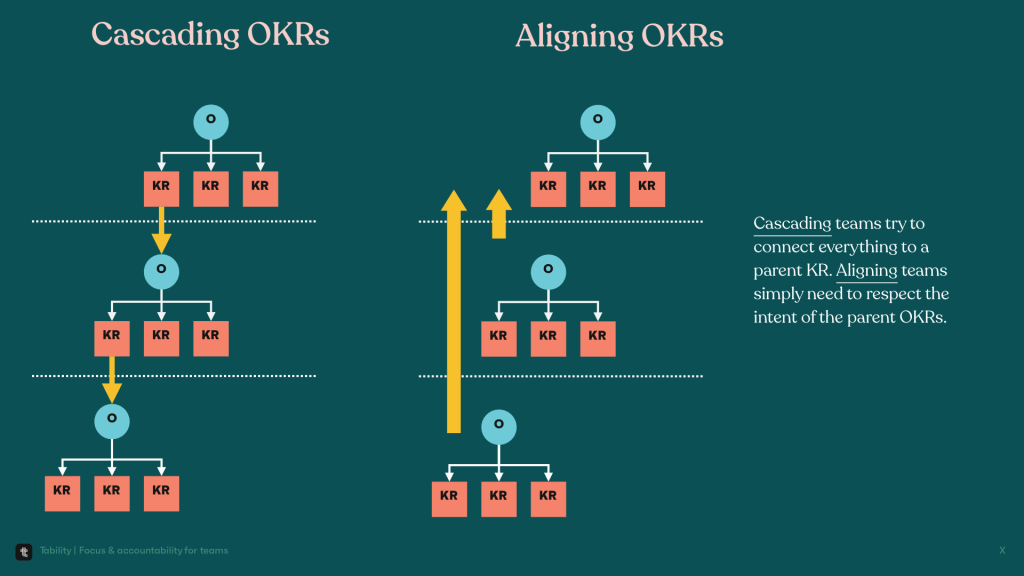
Image from Tability.io.
Conclusion
Aligning OKRs is a powerful approach to goal setting that fosters a culture of ownership, innovation, transparency, and adaptability. By empowering teams and individuals to set their own goals that contribute to the company’s overarching objectives, companies can create a sense of shared purpose and drive success in today’s competitive landscape.
.M
 Asterops
Leave a comment